Study railroad crossing decisions, grades, escape ramps, low gear planning, braking limits, and mountain-route hazards.
Last updated:
Where this page fits
Core CDL knowledge: CDL Railroad Crossings and Mountain Driving
This page is one checkpoint inside the CDL study guide. Use the map to move between the full outline, topic notes, practice questions, and focused weak-area review.
Check whether the vehicle must stop before a crossing.
Slow and choose control before a downgrade, curve, or crossing.
Avoid stopping where the vehicle cannot clear the tracks or hazard area.
Railroad crossings and mountain routes reward early planning. The safest answer usually slows before the hazard, checks carefully, and avoids waiting until the vehicle is already committed.
Railroad crossing scanning, stopping duties, and safe crossing decisions
Choosing safe speed before a downgrade
Using lower gears and controlled braking on grades
Escape ramps and emergency downgrade decisions
Route planning for grades, low clearance, and special vehicle restrictions
How to study this topic
Crossings require complete awareness
Railroad crossing questions test scanning, stopping when required, gear and speed choices, and whether the vehicle can clear the tracks without stopping on them.
Mountain driving starts before the hill
A heavy commercial vehicle should be slowed and placed in the right gear before a downgrade. Waiting until speed builds can leave fewer safe choices.
Use escape options correctly
Escape ramps and controlled emergency choices exist for situations where normal control has been compromised. They are not a substitute for proper speed and brake planning.
Practice questions
CDL Railroad Crossings and Mountain Driving Quiz
Answered 0 / 14
Question 1
How far ahead should you be looking while driving a commercial vehicle at highway speeds?
Good drivers look 12 to 15 seconds ahead. At highway speeds, this is about a quarter of a mile. This gives you time to adjust speed or change lanes to avoid hazards.
Study focusChoose safe speed, spacing, and visual search habits for commercial vehicles.
Common trapDriving at passenger-car speeds without accounting for weight, space, weather, or grade.
Question 2
When is it appropriate to use your high beams?
Use high beams whenever you can to see further ahead, provided it is safe and legal. You must dim them when within 500 feet of an oncoming vehicle or when following another vehicle within 500 feet.
Study focusApply core CDL safe-driving rules to common road and vehicle situations.
Common trapMemorizing rules without applying them to driving scenarios.
Question 3
Why should you avoid using the engine brake (Jake brake) on wet or icy roads?
Engine retarders (Jake brakes) apply strong braking force to the drive wheels only. On slippery surfaces, this sudden braking force can cause the drive wheels to lose traction, leading to a dangerous skid.
Study focusRespond safely to hazards, emergencies, traction loss, and unsafe conditions.
Common trapReacting late or using sudden braking/steering when controlled action is safer.
Question 4
What is the recommended following distance for a heavy vehicle traveling at 55 mph in ideal conditions?
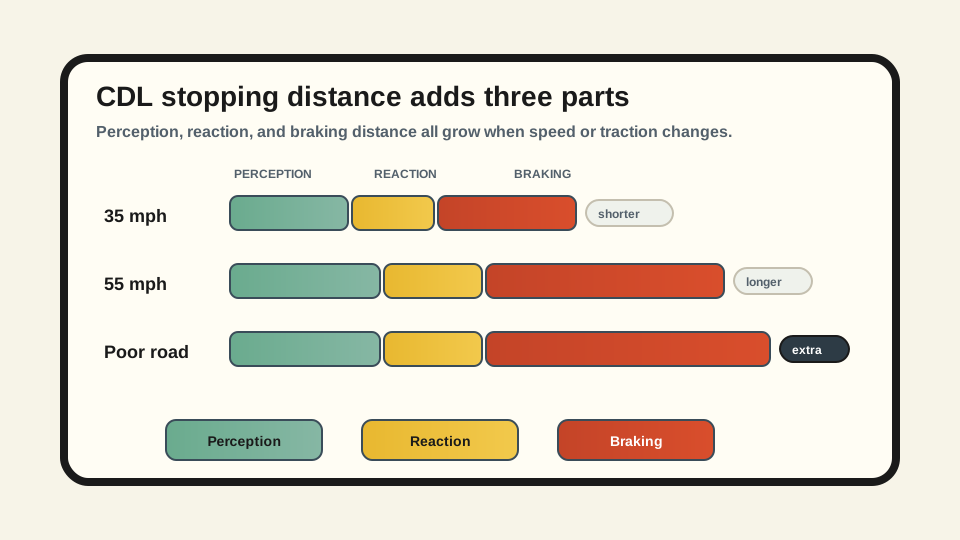
Stopping distance includes perception, reaction, and braking time.
The rule of thumb is 1 second of following distance for every 10 feet of vehicle length at speeds under 40 mph. For speeds over 40 mph, add 1 additional second. A 60-foot truck at 55 mph needs 7 seconds of space.
Study focusChoose safe speed, spacing, and visual search habits for commercial vehicles.
Common trapDriving at passenger-car speeds without accounting for weight, space, weather, or grade.
Question 5
Which of these is a sign of distracted driving?
Eating, using a phone, or reading while driving are major physical and cognitive distractions that take your eyes, hands, and mind away from the critical task of driving.
Study focusRespond safely to hazards, emergencies, traction loss, and unsafe conditions.
Common trapReacting late or using sudden braking/steering when controlled action is safer.
Question 6
What should you do if you are being tailgated?
If you are being tailgated, increase the space in front of your vehicle. This allows you to brake more smoothly and gradually, reducing the chance that the tailgater will crash into your rear.
Study focusChoose safe speed, spacing, and visual search habits for commercial vehicles.
Common trapDriving at passenger-car speeds without accounting for weight, space, weather, or grade.
Question 7
When approaching a curve, what is the best way to handle your speed?
You should brake to a safe speed before entering a curve. Once in the curve, maintain speed or accelerate slightly, as this helps stabilize the vehicle. Never brake hard in a curve.
Study focusChoose safe speed, spacing, and visual search habits for commercial vehicles.
Common trapDriving at passenger-car speeds without accounting for weight, space, weather, or grade.
Question 8
What must you do when placing warning devices (triangles) on a two-lane road with traffic in both directions?
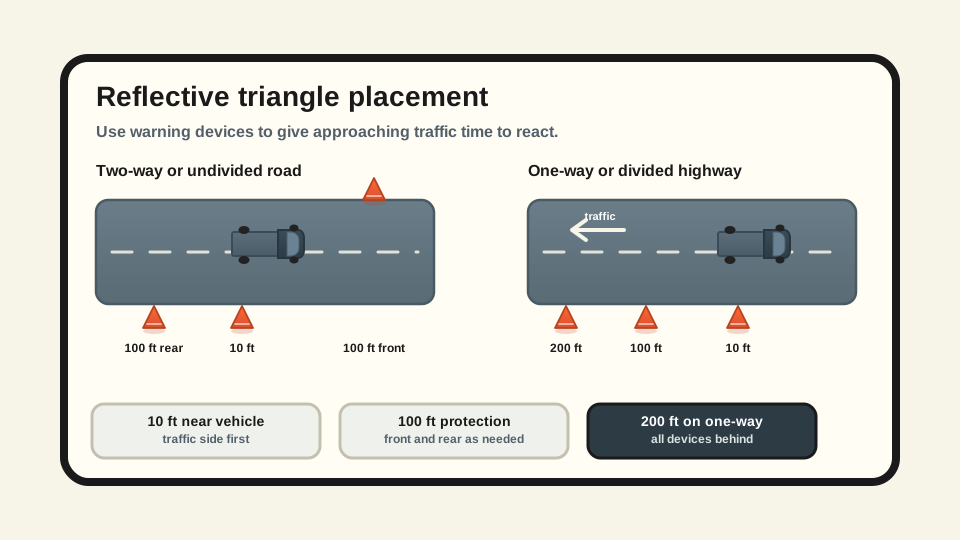
Warning-device placement depends on road type and traffic direction.
On a two-lane road carrying traffic in both directions, place warning devices within 10 feet of the front or rear corners, about 100 feet behind, and about 100 feet ahead of the vehicle.
Study focusRespond safely to hazards, emergencies, traction loss, and unsafe conditions.
Common trapReacting late or using sudden braking/steering when controlled action is safer.
Question 9
If you must pull over to the shoulder on a highway, how quickly must you place your warning devices?
Federal regulations require that emergency warning devices (like reflective triangles) be placed within 10 minutes of stopping on the shoulder or traveled portion of the road.
Study focusRespond safely to hazards, emergencies, traction loss, and unsafe conditions.
Common trapReacting late or using sudden braking/steering when controlled action is safer.
Question 10
What should you do if your vehicle begins to hydroplane?
To recover from hydroplaning, release the accelerator and push in the clutch. Do not use the brakes, as this can cause the wheels to lock and result in a skid.
Study focusRespond safely to hazards, emergencies, traction loss, and unsafe conditions.
Common trapReacting late or using sudden braking/steering when controlled action is safer.
Question 11
What is black ice?
Black ice is a thin layer of clear ice. Because it is clear, you can see the dark asphalt underneath, making the road appear wet rather than icy.
Study focusRespond safely to hazards, emergencies, traction loss, and unsafe conditions.
Common trapReacting late or using sudden braking/steering when controlled action is safer.
Question 12
When should you check your mirrors while driving?
You should check your mirrors regularly (about every 5 to 8 seconds) to be aware of traffic around you and to monitor your vehicle and trailer.
Study focusChoose safe speed, spacing, and visual search habits for commercial vehicles.
Common trapDriving at passenger-car speeds without accounting for weight, space, weather, or grade.
Question 13
What is the primary cause of fatal crashes involving commercial vehicles?
Speeding or driving too fast for conditions is the leading cause of fatal crashes involving large trucks.
Study focusChoose safe speed, spacing, and visual search habits for commercial vehicles.
Common trapDriving at passenger-car speeds without accounting for weight, space, weather, or grade.
Question 14
If you are driving a 60-foot truck at 50 mph, what is the minimum following distance you should maintain?
The rule is 1 second per 10 feet of length, plus 1 second if going over 40 mph. For a 60-foot truck, that is 6 seconds + 1 second = 7 seconds.
Study focusChoose safe speed, spacing, and visual search habits for commercial vehicles.
Common trapDriving at passenger-car speeds without accounting for weight, space, weather, or grade.