Your score review found missed questions about safe speed, following distance, grades, curves, or changing road conditions.
Last updated:
Study the weak area
What to understand before you answer.
Speed and space questions test judgment. A commercial vehicle needs more distance to stop, more room to turn, and more time to react than a passenger vehicle.
01
Adjust speed before curves, downgrades, traffic, poor visibility, and bad weather.
02
Increase following distance when the vehicle is heavy, the road is wet, or visibility is reduced.
03
Look far enough ahead to identify hazards before emergency braking becomes necessary.
04
Choose controlled speed and space over last-second steering or hard braking.
Before the questions
How to improve this score.
Review the safe-driving outline.
Answer this drill as if you are choosing the safest real driving action.
Mark missed questions by road condition: grade, curve, traffic, weather, or visibility.
Retake a mixed general knowledge set after this focused drill.
Common traps to watch for
Driving at passenger-car speeds without accounting for weight, space, weather, or grade.
When this pattern appears in a missed answer, review the explanation before trying another set.
Memorizing rules without applying them to driving scenarios.
When this pattern appears in a missed answer, review the explanation before trying another set.
Entering a crossing before there is room to clear it.
When this pattern appears in a missed answer, review the explanation before trying another set.
Treating a railroad crossing like an ordinary road segment.
When this pattern appears in a missed answer, review the explanation before trying another set.
Trying to solve downgrade speed after the vehicle is already too fast.
When this pattern appears in a missed answer, review the explanation before trying another set.
Practice questions
CDL Speed and Space Management Drill Quiz
Answered 0 / 20
Question 1
When road conditions become wet, what is the safest driving adjustment?
Wet roads reduce traction and increase stopping distance, so the safer adjustment is slower speed and more space.
Study focusChoose safe speed, spacing, and visual search habits for commercial vehicles.
Common trapDriving at passenger-car speeds without accounting for weight, space, weather, or grade.
Question 2
How far ahead should you be looking while driving a commercial vehicle at highway speeds?
Good drivers look 12 to 15 seconds ahead. At highway speeds, this is about a quarter of a mile. This gives you time to adjust speed or change lanes to avoid hazards.
Study focusChoose safe speed, spacing, and visual search habits for commercial vehicles.
Common trapDriving at passenger-car speeds without accounting for weight, space, weather, or grade.
Question 3
When is it appropriate to use your high beams?
Use high beams whenever you can to see further ahead, provided it is safe and legal. You must dim them when within 500 feet of an oncoming vehicle or when following another vehicle within 500 feet.
Study focusApply core CDL safe-driving rules to common road and vehicle situations.
Common trapMemorizing rules without applying them to driving scenarios.
Question 4
What is the recommended following distance for a heavy vehicle traveling at 55 mph in ideal conditions?
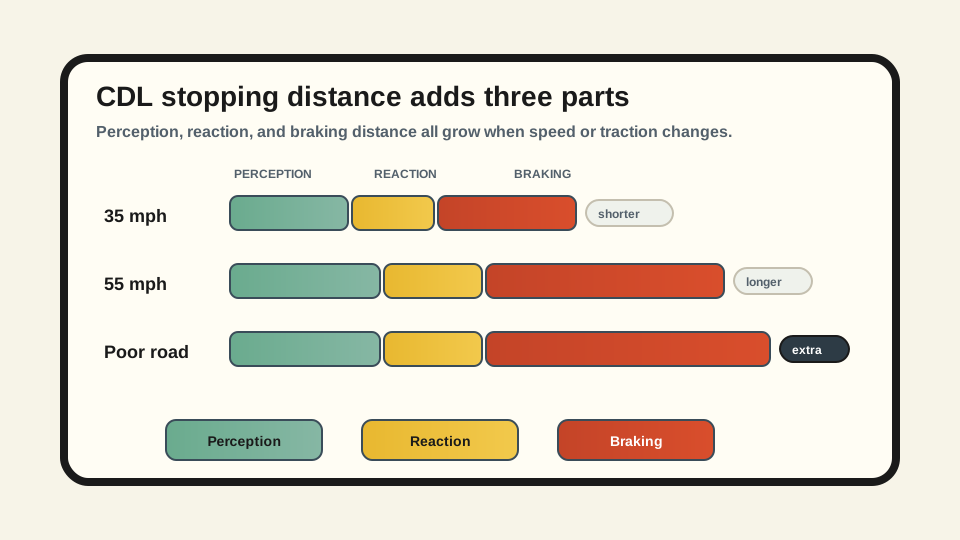
Stopping distance includes perception, reaction, and braking time.
The rule of thumb is 1 second of following distance for every 10 feet of vehicle length at speeds under 40 mph. For speeds over 40 mph, add 1 additional second. A 60-foot truck at 55 mph needs 7 seconds of space.
Study focusChoose safe speed, spacing, and visual search habits for commercial vehicles.
Common trapDriving at passenger-car speeds without accounting for weight, space, weather, or grade.
Question 5
What should you do if you are being tailgated?
If you are being tailgated, increase the space in front of your vehicle. This allows you to brake more smoothly and gradually, reducing the chance that the tailgater will crash into your rear.
Study focusChoose safe speed, spacing, and visual search habits for commercial vehicles.
Common trapDriving at passenger-car speeds without accounting for weight, space, weather, or grade.
Question 6
When approaching a curve, what is the best way to handle your speed?
You should brake to a safe speed before entering a curve. Once in the curve, maintain speed or accelerate slightly, as this helps stabilize the vehicle. Never brake hard in a curve.
Study focusChoose safe speed, spacing, and visual search habits for commercial vehicles.
Common trapDriving at passenger-car speeds without accounting for weight, space, weather, or grade.
Question 7
When should you check your mirrors while driving?
You should check your mirrors regularly (about every 5 to 8 seconds) to be aware of traffic around you and to monitor your vehicle and trailer.
Study focusChoose safe speed, spacing, and visual search habits for commercial vehicles.
Common trapDriving at passenger-car speeds without accounting for weight, space, weather, or grade.
Question 8
What is the primary cause of fatal crashes involving commercial vehicles?
Speeding or driving too fast for conditions is the leading cause of fatal crashes involving large trucks.
Study focusChoose safe speed, spacing, and visual search habits for commercial vehicles.
Common trapDriving at passenger-car speeds without accounting for weight, space, weather, or grade.
Question 9
If you are driving a 60-foot truck at 50 mph, what is the minimum following distance you should maintain?
The rule is 1 second per 10 feet of length, plus 1 second if going over 40 mph. For a 60-foot truck, that is 6 seconds + 1 second = 7 seconds.
Study focusChoose safe speed, spacing, and visual search habits for commercial vehicles.
Common trapDriving at passenger-car speeds without accounting for weight, space, weather, or grade.
Question 10
What should you do if an aggressive driver is harassing you?
To deal with an aggressive driver, do not engage. Get out of their way, avoid eye contact, ignore gestures, and report them if they are a severe danger.
Study focusChoose safe speed, spacing, and visual search habits for commercial vehicles.
Common trapDriving at passenger-car speeds without accounting for weight, space, weather, or grade.
Question 11
What is the best way to use the brake pedal on a steep downgrade?
The 'snubbing' technique involves braking firmly to 5 mph below your safe speed, then releasing them to allow cooling, repeating as necessary while the engine brake does most of the work.
Study focusChoose safe speed, spacing, and visual search habits for commercial vehicles.
Common trapDriving at passenger-car speeds without accounting for weight, space, weather, or grade.
Question 12
How can you tell if the road is becoming slippery due to dropping temperatures?
Mirrors and antennas are exposed to the cold air and will freeze before the road surface. If ice forms on them, be prepared for black ice on the road.
Study focusChoose safe speed, spacing, and visual search habits for commercial vehicles.
Common trapDriving at passenger-car speeds without accounting for weight, space, weather, or grade.
Question 13
When exiting a highway, when should you start slowing down?
You should maintain highway speed until you are in the deceleration lane, then brake to slow down to the posted ramp speed before entering the curve.
Study focusChoose safe speed, spacing, and visual search habits for commercial vehicles.
Common trapDriving at passenger-car speeds without accounting for weight, space, weather, or grade.
Question 14
How do you dry wet brakes after driving through deep water?
To dry wet brakes, slow down, put the truck in a low gear, and lightly apply the brakes for a short distance. The friction generates heat which dries the linings.
Study focusApply core CDL safe-driving rules to common road and vehicle situations.
Common trapMemorizing rules without applying them to driving scenarios.
Question 15
Which of these is true about proper mirror adjustment?
Mirrors should be adjusted prior to starting the trip so you can see a small portion of your vehicle's side as a reference point to judge where other objects are.
Study focusChoose safe speed, spacing, and visual search habits for commercial vehicles.
Common trapDriving at passenger-car speeds without accounting for weight, space, weather, or grade.
Question 16
You are approaching a railroad crossing in a heavy commercial vehicle. What is the safest general habit?
Railroad crossings require early observation and enough space beyond the tracks. A commercial vehicle should not enter unless it can clear the crossing safely.