Your score review found missed questions about emergencies, warnings, skids, traction loss, or unsafe road conditions.
Last updated:
Study the weak area
What to understand before you answer.
Hazard response questions check whether you can choose the safest controlled action under pressure. The best answer usually reduces speed, keeps control, warns others, or avoids making the hazard worse.
01
Separate sudden hazards from predictable hazards that should be managed earlier.
02
Avoid abrupt braking or steering when a controlled response is safer.
03
Use warnings, space, and speed reduction before the situation becomes an emergency.
04
For skids or traction loss, prioritize control before acceleration or hard braking.
Before the questions
How to improve this score.
Review the explanations for every missed hazard question.
Group misses by hazard type: skid, fire, warning, downgrade, or poor visibility.
Repeat this drill until the safest action feels obvious.
Move back to general knowledge when hazard misses are no longer grouped together.
Common traps to watch for
Reacting late or using sudden braking/steering when controlled action is safer.
When this pattern appears in a missed answer, review the explanation before trying another set.
Treating an escape ramp as a normal parking or convenience area.
When this pattern appears in a missed answer, review the explanation before trying another set.
Using short-term stimulation instead of stopping to rest.
When this pattern appears in a missed answer, review the explanation before trying another set.
Escalating conflict instead of creating space.
When this pattern appears in a missed answer, review the explanation before trying another set.
Thinking a short distraction is harmless in a large vehicle.
When this pattern appears in a missed answer, review the explanation before trying another set.
Practice questions
CDL Hazard Response Drill Quiz
Answered 0 / 20
Question 1
Why should you avoid using the engine brake (Jake brake) on wet or icy roads?
Engine retarders (Jake brakes) apply strong braking force to the drive wheels only. On slippery surfaces, this sudden braking force can cause the drive wheels to lose traction, leading to a dangerous skid.
Study focusRespond safely to hazards, emergencies, traction loss, and unsafe conditions.
Common trapReacting late or using sudden braking/steering when controlled action is safer.
Question 2
Which of these is a sign of distracted driving?
Eating, using a phone, or reading while driving are major physical and cognitive distractions that take your eyes, hands, and mind away from the critical task of driving.
Study focusRespond safely to hazards, emergencies, traction loss, and unsafe conditions.
Common trapReacting late or using sudden braking/steering when controlled action is safer.
Question 3
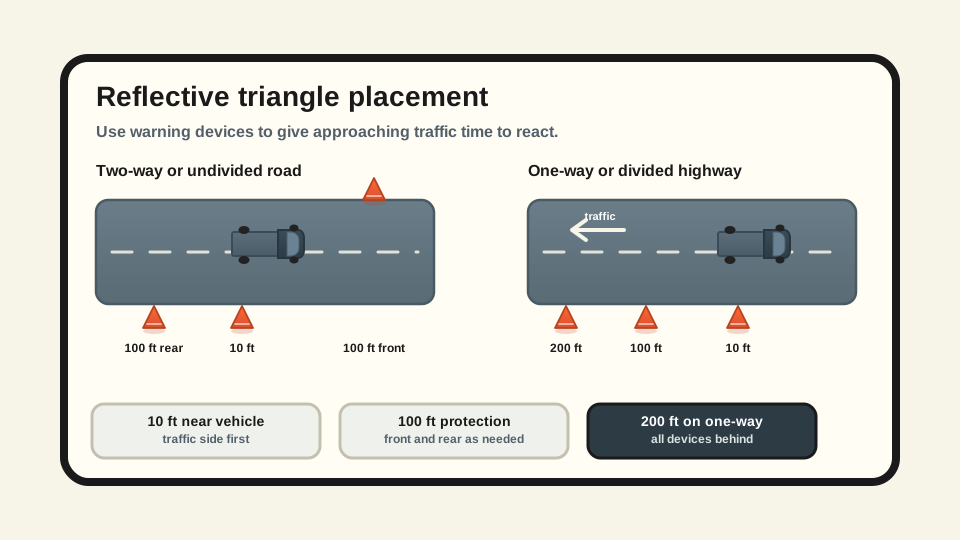
What must you do when placing warning devices (triangles) on a two-lane road with traffic in both directions?
Warning-device placement depends on road type and traffic direction.
On a two-lane road carrying traffic in both directions, place warning devices within 10 feet of the front or rear corners, about 100 feet behind, and about 100 feet ahead of the vehicle.
Study focusRespond safely to hazards, emergencies, traction loss, and unsafe conditions.
Common trapReacting late or using sudden braking/steering when controlled action is safer.
Question 4
If you must pull over to the shoulder on a highway, how quickly must you place your warning devices?
Federal regulations require that emergency warning devices (like reflective triangles) be placed within 10 minutes of stopping on the shoulder or traveled portion of the road.
Study focusRespond safely to hazards, emergencies, traction loss, and unsafe conditions.
Common trapReacting late or using sudden braking/steering when controlled action is safer.
Question 5
What should you do if your vehicle begins to hydroplane?
To recover from hydroplaning, release the accelerator and push in the clutch. Do not use the brakes, as this can cause the wheels to lock and result in a skid.
Study focusRespond safely to hazards, emergencies, traction loss, and unsafe conditions.
Common trapReacting late or using sudden braking/steering when controlled action is safer.
Question 6
What is black ice?
Black ice is a thin layer of clear ice. Because it is clear, you can see the dark asphalt underneath, making the road appear wet rather than icy.
Study focusRespond safely to hazards, emergencies, traction loss, and unsafe conditions.
Common trapReacting late or using sudden braking/steering when controlled action is safer.
Question 7
What is the primary danger of driving through deep puddles of water?
Driving through deep water can soak the brake linings. Wet brakes can be weak, apply unevenly, or grab, leading to a lack of braking power or a skid.
Study focusRespond safely to hazards, emergencies, traction loss, and unsafe conditions.
Common trapReacting late or using sudden braking/steering when controlled action is safer.
Question 8
What is the safest reason to use an escape ramp?
Escape ramps are emergency features for runaway or uncontrollable vehicles on grades. They are not routine stopping areas.