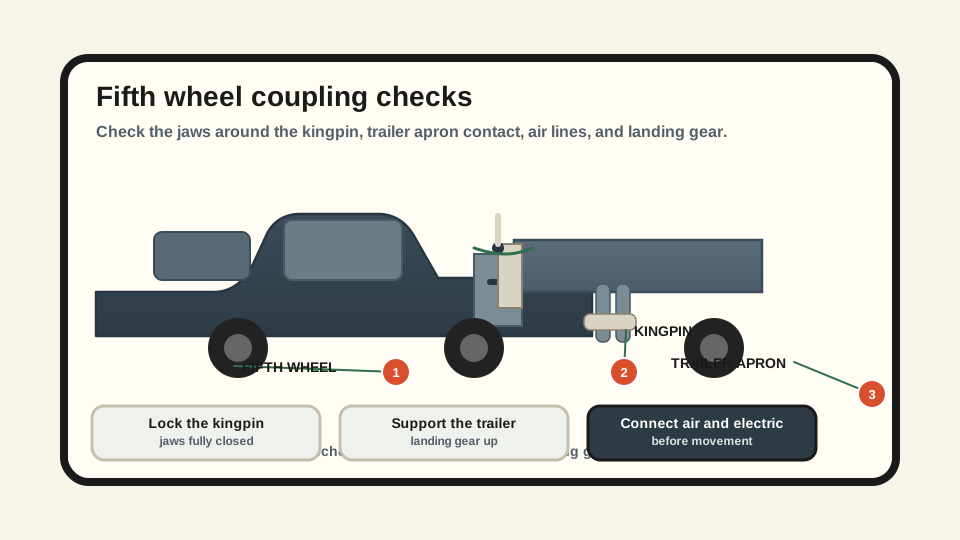
Your score review found missed questions about coupling, uncoupling, fifth wheel checks, kingpin position, locking jaws, or trailer air/electrical connections.
Last updated:
Study the weak area
What to understand before you answer.
Coupling questions test sequence and verification. The safest answer usually confirms that the trailer is actually connected, locked, supported, and ready before movement.
01
Know what the fifth wheel, kingpin, locking jaws, glad hands, and landing gear do.
02
Treat the visual inspection after coupling as essential, not optional.
03
Watch for sequence questions that ask what comes before moving the vehicle.
04
Do not confuse coupling checks with normal road-driving decisions.
Before the questions
How to improve this score.
Review the combination vehicles study page.
Answer each question as a safety sequence.
Review missed explanations for skipped verification steps.
Return to combination vehicle practice after the coupling sequence is solid.
Common traps to watch for
Skipping visual checks after coupling or confusing kingpin contact points.
When this pattern appears in a missed answer, review the explanation before trying another set.
Using a tug test as a replacement for full coupling checks.
When this pattern appears in a missed answer, review the explanation before trying another set.
Assuming the trailer is connected because it appears close to the tractor.
When this pattern appears in a missed answer, review the explanation before trying another set.
Assuming the trailer is secure without a visual coupling check.
When this pattern appears in a missed answer, review the explanation before trying another set.
Practice questions
CDL Coupling System Drill Quiz
Answered 0 / 20
Question 1
Which part of the kingpin should the locking jaws close around?
Fifth wheel and kingpin coupling
When properly coupled, the locking jaws of the fifth wheel must close securely around the shank (the narrower middle part) of the kingpin, not the head or the base.
Study focusRecognize safe coupling, uncoupling, fifth wheel, kingpin, and trailer air-line checks.
Common trapSkipping visual checks after coupling or confusing kingpin contact points.
Question 2
What color are the trailer air lines (glad hands) usually painted?
To prevent crossing the lines, glad hands are color-coded: Blue is used for the service (control) line, and Red is used for the emergency (supply) line.
Study focusRecognize safe coupling, uncoupling, fifth wheel, kingpin, and trailer air-line checks.
Common trapSkipping visual checks after coupling or confusing kingpin contact points.
Question 3
When coupling a semi-trailer, how should you test that the fifth wheel jaws have locked around the kingpin?
After coupling, always pull gently forward while the trailer brakes are locked. This 'tug test' ensures the locking jaws have securely grabbed the kingpin.
Study focusRecognize safe coupling, uncoupling, fifth wheel, kingpin, and trailer air-line checks.
Common trapSkipping visual checks after coupling or confusing kingpin contact points.
Question 4
Before backing under a trailer, what should you do with the trailer height?
The trailer should be at a height where the front of the trailer is lifted slightly by the tractor's fifth wheel as it backs under. If it's too high, the kingpin could slide over the fifth wheel.
Study focusRecognize safe coupling, uncoupling, fifth wheel, kingpin, and trailer air-line checks.
Common trapSkipping visual checks after coupling or confusing kingpin contact points.
Question 5
Where should the tractor be positioned when uncoupling a trailer?
You should always align the tractor straight with the trailer when uncoupling. Pulling out at an angle can damage the landing gear or cause the trailer to fall.
Study focusRecognize safe coupling, uncoupling, fifth wheel, kingpin, and trailer air-line checks.
Common trapSkipping visual checks after coupling or confusing kingpin contact points.
Question 6
After uncoupling a trailer, what is a crucial safety step before driving away?
Always verify that the landing gear is secure, fully lowered, and resting on solid ground (with pads or wood blocks if needed) before pulling the tractor away from the trailer.
Study focusRecognize safe coupling, uncoupling, fifth wheel, kingpin, and trailer air-line checks.
Common trapSkipping visual checks after coupling or confusing kingpin contact points.
Question 7
What should you check regarding the space between the upper and lower fifth wheel after coupling?
There must be absolutely no space between the upper and lower fifth wheel. If there is space, the kingpin may be resting on top of the locking jaws, which is extremely dangerous.
Study focusRecognize safe coupling, uncoupling, fifth wheel, kingpin, and trailer air-line checks.
Common trapSkipping visual checks after coupling or confusing kingpin contact points.
Question 8
Where are the glad hands located?
Glad hands are the coupling devices used to connect the service and emergency air lines from the truck or tractor to the trailer.
Study focusRecognize safe coupling, uncoupling, fifth wheel, kingpin, and trailer air-line checks.
Common trapSkipping visual checks after coupling or confusing kingpin contact points.
Question 9
How do you connect the glad hands?
Glad hands are connected by pressing the rubber seals together at a 90-degree angle and twisting them until they lock into a straight line.
Study focusRecognize safe coupling, uncoupling, fifth wheel, kingpin, and trailer air-line checks.
Common trapSkipping visual checks after coupling or confusing kingpin contact points.
Question 10
What are 'dummy couplers' (dead-end receptacles)?
When operating bobtail, the glad hands should be attached to dummy couplers to protect the air lines from dirt, water, and insects.
Study focusRecognize safe coupling, uncoupling, fifth wheel, kingpin, and trailer air-line checks.
Common trapSkipping visual checks after coupling or confusing kingpin contact points.
Question 11
What is the apron of the trailer?
The trailer apron is the solid steel plate located at the front underside of the trailer, which houses the kingpin and rests flat on the tractor's fifth wheel.
Study focusRecognize safe coupling, uncoupling, fifth wheel, kingpin, and trailer air-line checks.
Common trapSkipping visual checks after coupling or confusing kingpin contact points.
Question 12
How much clearance should there be between the tractor frame and the landing gear during a turn?
You must check visually that there is enough clearance between the tractor frame and the landing gear, especially for trailers with landing gear mounted close to the front.
Study focusRecognize safe coupling, uncoupling, fifth wheel, kingpin, and trailer air-line checks.
Common trapSkipping visual checks after coupling or confusing kingpin contact points.
Question 13
When uncoupling a loaded trailer, after lowering the landing gear to the ground, what should you do?
For a loaded trailer, turn the crank a few extra times in low gear after the pads touch the ground. This lifts some weight off the fifth wheel, making it easier to release the latch and pull away.
Study focusRecognize safe coupling, uncoupling, fifth wheel, kingpin, and trailer air-line checks.
Common trapSkipping visual checks after coupling or confusing kingpin contact points.
Question 14
When uncoupling an empty trailer, how should the landing gear be set?
For an empty trailer, stop cranking right when the pads make firm contact with the ground. Lifting an empty trailer too high can make it difficult to couple next time.
Study focusRecognize safe coupling, uncoupling, fifth wheel, kingpin, and trailer air-line checks.
Common trapSkipping visual checks after coupling or confusing kingpin contact points.
Question 15
What is the correct procedure for testing the tractor protection valve?
To test the tractor protection valve, you fan the brakes to bleed off air pressure. The red knob should pop out, closing the valve to protect the tractor's air supply.
Study focusRecognize safe coupling, uncoupling, fifth wheel, kingpin, and trailer air-line checks.
Common trapSkipping visual checks after coupling or confusing kingpin contact points.
Question 16
If the fifth wheel locking lever is not pushed all the way in and secured with the safety catch, what does this indicate?
The locking lever must be fully seated and the safety catch engaged. If it is not, the jaws are not locked securely, and you must not drive the vehicle.
Study focusRecognize safe coupling, uncoupling, fifth wheel, kingpin, and trailer air-line checks.
Common trapSkipping visual checks after coupling or confusing kingpin contact points.
Question 17
What is the 'kingpin'?
The kingpin is the thick steel pin located under the front of the trailer (on the apron) that securely engages with the locking jaws of the tractor's fifth wheel.
Study focusRecognize safe coupling, uncoupling, fifth wheel, kingpin, and trailer air-line checks.
Common trapSkipping visual checks after coupling or confusing kingpin contact points.
Question 18
What does a tug or pull test help verify after coupling?
A controlled tug or pull test helps confirm that coupling is secure. It does not replace visual and system checks.
Source focusCDL Manual - Combination Vehicles and Doubles/Triples: coupling
Study focusUnderstand the purpose and limits of a tug test.
Common trapUsing a tug test as a replacement for full coupling checks.
Question 19
In a combination vehicle pre-trip inspection, what coupling item should be confirmed before moving?
The coupling must be secure before movement. Locked fifth wheel jaws around the kingpin are a critical coupling check.