Practice for coupling, uncoupling, turning behavior, trailer risks, and safe combination operation.
Last updated:
Where this page fits
Combination vehicles: CDL Combination Vehicles
This page is one checkpoint inside the CDL study guide. Use the map to move between the full outline, topic notes, practice questions, and focused weak-area review.
Visualize the trailer path, not only the tractor path.
Use slower speed and smoother steering before curves, ramps, and turns.
Treat abrupt movement as a rollover and lane-control risk.
Combination vehicle questions usually test coupling, uncoupling, turning, trailer movement, brake checks, safe spacing, and common CDL combination test wording.
CDL combination test questions and trailer-control explanations
Coupling and uncoupling sequence
Trailer off-tracking and turn planning
Rollover and rearward amplification risk
Combination vehicle brake checks
Following distance and lane control
How to study this topic
Practice depth
The topic supports direct recall, inspection sequence, road geometry, and trailer hazard questions.
Related topics
After this topic, review Class A practice, air brakes, doubles/triples, and any endorsement topics required for your license.
Practice questions
CDL Combination Vehicles Quiz
Answered 0 / 40
Question 1
Why is the risk of a rollover higher in a combination vehicle compared to a single vehicle?
Fully loaded rigs have high centers of gravity, making them top-heavy. Also, in a multi-trailer combination, steering movements are amplified at the rear (the crack-the-whip effect), greatly increasing rollover risk.
Study focusControl off-tracking, rollover, rearward amplification, and trailer movement risks.
Common trapTurning or steering too sharply without accounting for trailer movement.
Question 2
What is 'off-tracking' (or 'cheating') in a combination vehicle?
Off-tracking occurs when turning. The rear wheels follow a shorter path than the front wheels. The longer the vehicle, the greater the off-tracking, requiring wider turns.
Study focusControl off-tracking, rollover, rearward amplification, and trailer movement risks.
Common trapTurning or steering too sharply without accounting for trailer movement.
Question 3
Which part of the kingpin should the locking jaws close around?
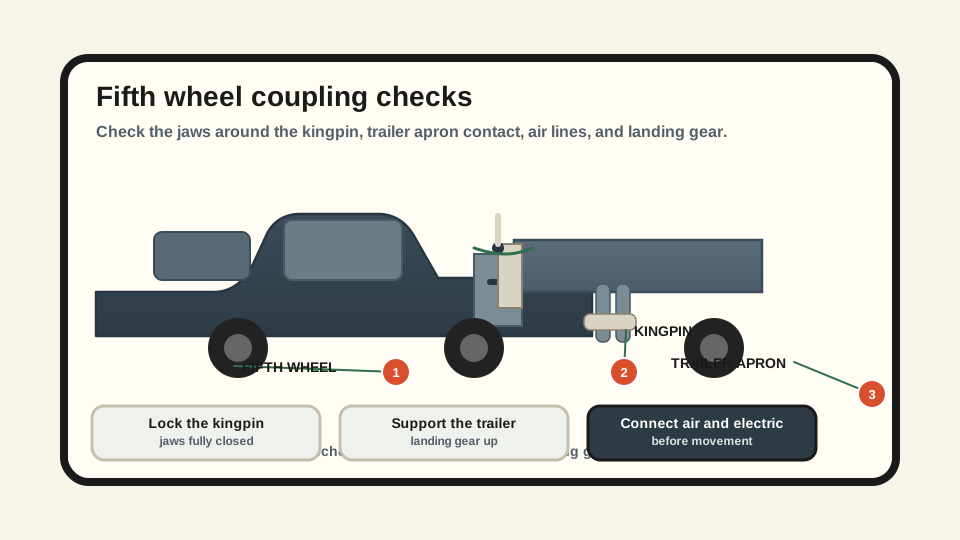
Fifth wheel and kingpin coupling
When properly coupled, the locking jaws of the fifth wheel must close securely around the shank (the narrower middle part) of the kingpin, not the head or the base.
Study focusRecognize safe coupling, uncoupling, fifth wheel, kingpin, and trailer air-line checks.
Common trapSkipping visual checks after coupling or confusing kingpin contact points.
Question 4
What color are the trailer air lines (glad hands) usually painted?
To prevent crossing the lines, glad hands are color-coded: Blue is used for the service (control) line, and Red is used for the emergency (supply) line.
Study focusRecognize safe coupling, uncoupling, fifth wheel, kingpin, and trailer air-line checks.
Common trapSkipping visual checks after coupling or confusing kingpin contact points.
Question 5
If you cross the air lines when hooking up to an older trailer, what will happen?
If lines are crossed, air goes to the service brakes instead of releasing the spring brakes. You won't be able to move (if spring brakes are working) or you won't have service brakes (if spring brakes are broken/missing on older trailers).
Study focusUnderstand how spring brakes and parking brakes behave when air pressure changes.
Common trapAssuming parking brakes work independently of air pressure behavior.
Question 6
What is the purpose of the trailer hand valve (trolley valve or Johnson bar)?
The trailer hand valve allows you to apply only the trailer brakes. It should be used to test trailer brakes but never used for parking or during normal driving because of the risk of causing a jackknife.
Study focusControl off-tracking, rollover, rearward amplification, and trailer movement risks.
Common trapTurning or steering too sharply without accounting for trailer movement.
Question 7
What does the tractor protection valve do?
The tractor protection valve closes automatically if air pressure drops too low. This keeps air in the tractor to ensure the driver still has tractor brakes even if the trailer is lost or severely leaking.
Study focusRecognize low air pressure warnings and choose the safest response.
Common trapIgnoring a low air warning or waiting until spring brakes apply.
Question 8
When coupling a semi-trailer, how should you test that the fifth wheel jaws have locked around the kingpin?
After coupling, always pull gently forward while the trailer brakes are locked. This 'tug test' ensures the locking jaws have securely grabbed the kingpin.
Study focusRecognize safe coupling, uncoupling, fifth wheel, kingpin, and trailer air-line checks.
Common trapSkipping visual checks after coupling or confusing kingpin contact points.
Question 9
Before backing under a trailer, what should you do with the trailer height?
The trailer should be at a height where the front of the trailer is lifted slightly by the tractor's fifth wheel as it backs under. If it's too high, the kingpin could slide over the fifth wheel.
Study focusRecognize safe coupling, uncoupling, fifth wheel, kingpin, and trailer air-line checks.
Common trapSkipping visual checks after coupling or confusing kingpin contact points.
Question 10
What causes a trailer jackknife?
A trailer jackknife occurs when the trailer wheels lock up, lose traction, and the trailer swings outward alongside the tractor. Releasing the brakes to let the trailer wheels roll is the way to recover.
Study focusControl off-tracking, rollover, rearward amplification, and trailer movement risks.
Common trapTurning or steering too sharply without accounting for trailer movement.
Question 11
Where should the tractor be positioned when uncoupling a trailer?
You should always align the tractor straight with the trailer when uncoupling. Pulling out at an angle can damage the landing gear or cause the trailer to fall.
Study focusRecognize safe coupling, uncoupling, fifth wheel, kingpin, and trailer air-line checks.
Common trapSkipping visual checks after coupling or confusing kingpin contact points.
Question 12
After uncoupling a trailer, what is a crucial safety step before driving away?
Always verify that the landing gear is secure, fully lowered, and resting on solid ground (with pads or wood blocks if needed) before pulling the tractor away from the trailer.
Study focusRecognize safe coupling, uncoupling, fifth wheel, kingpin, and trailer air-line checks.
Common trapSkipping visual checks after coupling or confusing kingpin contact points.
Question 13
What should you check regarding the space between the upper and lower fifth wheel after coupling?
There must be absolutely no space between the upper and lower fifth wheel. If there is space, the kingpin may be resting on top of the locking jaws, which is extremely dangerous.
Study focusRecognize safe coupling, uncoupling, fifth wheel, kingpin, and trailer air-line checks.
Common trapSkipping visual checks after coupling or confusing kingpin contact points.
Question 14
When supplying air to a trailer, at what pressure should the trailer emergency brakes release?
The trailer spring brakes (emergency brakes) release when you push in the red trailer air supply valve and air pressure builds up in the trailer's emergency system.
Study focusUnderstand how spring brakes and parking brakes behave when air pressure changes.
Common trapAssuming parking brakes work independently of air pressure behavior.
Question 15
What is the 'crack-the-whip' effect?
When a driver makes a quick lane change or sudden steering movement, the movement is amplified at the rear of the combination. The last trailer swings out violently, which often leads to a rollover.
Study focusControl off-tracking, rollover, rearward amplification, and trailer movement risks.
Common trapTurning or steering too sharply without accounting for trailer movement.
Question 16
How should you drive when pulling an empty trailer?
Empty trailers have less traction and bounce more. Therefore, they actually take longer to stop than loaded trailers (because the tires lock up easily) and are more susceptible to wind and jackknifing.
Study focusUnderstand cargo weight, securement, and load safety responsibilities.
Common trapAssuming cargo safety is only the shipper or dispatcher responsibility.
Question 17
When inspecting the trailer before coupling, you should make sure the trailer wheels are:
Before backing under a trailer, ensure the trailer wheels are chocked (blocked) or the spring brakes are properly applied so the trailer doesn't roll away when you push against it with the fifth wheel.
Study focusUnderstand how spring brakes and parking brakes behave when air pressure changes.
Common trapAssuming parking brakes work independently of air pressure behavior.
Question 18
What is a 'bobtail'?
A bobtail is a tractor operating without a trailer attached. Bobtails can be surprisingly difficult to stop safely due to the lack of weight over the rear drive axles.
Study focusUnderstand cargo weight, securement, and load safety responsibilities.
Common trapAssuming cargo safety is only the shipper or dispatcher responsibility.
Question 19
When uncoupling, why do you apply the parking brakes, lower the landing gear, and disconnect the air lines BEFORE pulling the fifth wheel release handle?
You secure the trailer (brakes and landing gear) and disconnect lines first so that when you finally release the kingpin and pull away, the trailer is fully supported and won't rip the air lines out.
Study focusUnderstand how spring brakes and parking brakes behave when air pressure changes.
Common trapAssuming parking brakes work independently of air pressure behavior.
Question 20
How can you prevent a rollover?
To prevent rollovers, keep the center of gravity low by distributing weight properly, load cargo evenly, and significantly reduce your speed before entering curves and ramps.
Study focusControl off-tracking, rollover, rearward amplification, and trailer movement risks.
Common trapTurning or steering too sharply without accounting for trailer movement.
Question 21
Why should you never use the trailer hand valve while driving?
Using the trailer hand valve during normal driving can easily cause the trailer wheels to lock up, which will lead to a trailer jackknife.
Study focusControl off-tracking, rollover, rearward amplification, and trailer movement risks.
Common trapTurning or steering too sharply without accounting for trailer movement.
Question 22
What is the purpose of the trailer air supply control valve (the red octagonal knob)?
The red trailer air supply valve is pushed in to supply air to the trailer (releasing the trailer emergency brakes) and pulled out to shut off the air and apply the trailer emergency brakes.
Study focusUnderstand how spring brakes and parking brakes behave when air pressure changes.
Common trapAssuming parking brakes work independently of air pressure behavior.
Question 23
If the service air line comes apart while you are driving, what will happen?
If only the service (blue) line breaks, you won't notice until you press the brake pedal. Then, air will escape, causing the system pressure to drop until the tractor protection valve closes and the trailer emergency brakes apply.
Study focusUnderstand how spring brakes and parking brakes behave when air pressure changes.
Common trapAssuming parking brakes work independently of air pressure behavior.
Question 24
If the emergency air line comes apart while you are driving, what will happen?
If the emergency (red) line breaks, the sudden loss of air pressure in the trailer emergency line will cause the trailer's relay valves to immediately apply the trailer's spring (emergency) brakes.
Study focusRespond safely to hazards, emergencies, traction loss, and unsafe conditions.
Common trapReacting late or using sudden braking/steering when controlled action is safer.
Question 25
What does a trailer relay valve do?
Relay valves are used on trailers to speed up the flow of air from the trailer tanks to the trailer brake chambers, minimizing brake lag.
Study focusIdentify key air brake parts and explain how the system produces braking force.
Common trapMemorizing part names without understanding what each part does.
Question 26
Where are the glad hands located?
Glad hands are the coupling devices used to connect the service and emergency air lines from the truck or tractor to the trailer.
Study focusRecognize safe coupling, uncoupling, fifth wheel, kingpin, and trailer air-line checks.
Common trapSkipping visual checks after coupling or confusing kingpin contact points.
Question 27
How do you connect the glad hands?
Glad hands are connected by pressing the rubber seals together at a 90-degree angle and twisting them until they lock into a straight line.
Study focusRecognize safe coupling, uncoupling, fifth wheel, kingpin, and trailer air-line checks.
Common trapSkipping visual checks after coupling or confusing kingpin contact points.
Question 28
Why should you keep the glad hands clean and check the rubber grommets (seals)?
Damaged or dirty seals will cause air leaks, which can lead to a loss of air pressure and unexpected application of the emergency brakes.
Study focusUnderstand how spring brakes and parking brakes behave when air pressure changes.
Common trapAssuming parking brakes work independently of air pressure behavior.
Question 29
What are 'dummy couplers' (dead-end receptacles)?
When operating bobtail, the glad hands should be attached to dummy couplers to protect the air lines from dirt, water, and insects.
Study focusRecognize safe coupling, uncoupling, fifth wheel, kingpin, and trailer air-line checks.
Common trapSkipping visual checks after coupling or confusing kingpin contact points.
Question 30
When testing the trailer service brakes with the trailer hand valve, you should hear:
When you apply and release the trailer hand valve, you should hear the brakes move and hear the air exhaust out of the relay valve at the rear of the trailer.
Study focusIdentify key air brake parts and explain how the system produces braking force.
Common trapMemorizing part names without understanding what each part does.
Question 31
Before backing under a trailer, the trailer brakes should be:
The trailer must be secured so it doesn't roll backwards when the tractor backs into it. Ensure the spring brakes are on or the wheels are chocked.
Study focusUnderstand how spring brakes and parking brakes behave when air pressure changes.
Common trapAssuming parking brakes work independently of air pressure behavior.
Question 32
What is the apron of the trailer?
The trailer apron is the solid steel plate located at the front underside of the trailer, which houses the kingpin and rests flat on the tractor's fifth wheel.
Study focusRecognize safe coupling, uncoupling, fifth wheel, kingpin, and trailer air-line checks.
Common trapSkipping visual checks after coupling or confusing kingpin contact points.
Question 33
What could happen if you forget to connect the emergency (red) air line before moving a newly coupled trailer?
The emergency air line supplies air to release the trailer's spring brakes. Without it connected, the spring brakes stay fully engaged and the trailer wheels are locked. Attempting to drive will damage tires, brakes, and potentially the drivetrain.
Study focusUnderstand how spring brakes and parking brakes behave when air pressure changes.
Common trapAssuming parking brakes work independently of air pressure behavior.
Question 34
How much clearance should there be between the tractor frame and the landing gear during a turn?
You must check visually that there is enough clearance between the tractor frame and the landing gear, especially for trailers with landing gear mounted close to the front.
Study focusRecognize safe coupling, uncoupling, fifth wheel, kingpin, and trailer air-line checks.
Common trapSkipping visual checks after coupling or confusing kingpin contact points.
Question 35
When uncoupling a loaded trailer, after lowering the landing gear to the ground, what should you do?
For a loaded trailer, turn the crank a few extra times in low gear after the pads touch the ground. This lifts some weight off the fifth wheel, making it easier to release the latch and pull away.
Study focusRecognize safe coupling, uncoupling, fifth wheel, kingpin, and trailer air-line checks.
Common trapSkipping visual checks after coupling or confusing kingpin contact points.
Question 36
When uncoupling an empty trailer, how should the landing gear be set?
For an empty trailer, stop cranking right when the pads make firm contact with the ground. Lifting an empty trailer too high can make it difficult to couple next time.
Study focusRecognize safe coupling, uncoupling, fifth wheel, kingpin, and trailer air-line checks.
Common trapSkipping visual checks after coupling or confusing kingpin contact points.
Question 37
What is the correct procedure for testing the tractor protection valve?
To test the tractor protection valve, you fan the brakes to bleed off air pressure. The red knob should pop out, closing the valve to protect the tractor's air supply.
Study focusRecognize safe coupling, uncoupling, fifth wheel, kingpin, and trailer air-line checks.
Common trapSkipping visual checks after coupling or confusing kingpin contact points.
Question 38
If the fifth wheel locking lever is not pushed all the way in and secured with the safety catch, what does this indicate?
The locking lever must be fully seated and the safety catch engaged. If it is not, the jaws are not locked securely, and you must not drive the vehicle.
Study focusRecognize safe coupling, uncoupling, fifth wheel, kingpin, and trailer air-line checks.
Common trapSkipping visual checks after coupling or confusing kingpin contact points.
Question 39
What is the 'kingpin'?
The kingpin is the thick steel pin located under the front of the trailer (on the apron) that securely engages with the locking jaws of the tractor's fifth wheel.
Study focusRecognize safe coupling, uncoupling, fifth wheel, kingpin, and trailer air-line checks.
Common trapSkipping visual checks after coupling or confusing kingpin contact points.
Question 40
Why is it important to connect the air lines and supply air to the trailer before backing fully under it?
Connecting the air lines allows you to supply air to the system and then use the trailer brakes (or let the spring brakes hold it) to ensure the trailer stays perfectly still when the fifth wheel pushes against the kingpin.
Study focusUnderstand how spring brakes and parking brakes behave when air pressure changes.
Common trapAssuming parking brakes work independently of air pressure behavior.