Use this set after reading the school bus study page or when student-safety decisions need focused review.
Last updated:
Study the weak area
What to understand before you answer.
School bus practice centers on students around a large vehicle. The safest answer usually controls traffic, watches danger zones, and protects students before schedule.
01
Track where students are before the bus moves.
02
Use mirrors, warnings, and counting during loading and unloading.
03
Treat evacuation and crossings as student-safety decisions.
Before the questions
How to improve this score.
Read the school bus study page.
Answer the practice set.
Review misses by loading, danger zone, crossing, inspection, or evacuation.
Use the school bus safety drill if one pattern repeats.
Common traps to watch for
Treating a school bus stop like a normal passenger stop instead of a student-safety event.
When this pattern appears in a missed answer, review the explanation before trying another set.
Letting students cross before traffic is fully controlled.
When this pattern appears in a missed answer, review the explanation before trying another set.
Assuming students are clear because the door has closed.
When this pattern appears in a missed answer, review the explanation before trying another set.
Prioritizing route timing over controlling student movement.
When this pattern appears in a missed answer, review the explanation before trying another set.
Checking mirrors only once and assuming all students are gone.
When this pattern appears in a missed answer, review the explanation before trying another set.
Practice questions
CDL School Bus Test 1 Quiz
Answered 0 / 15
Question 1
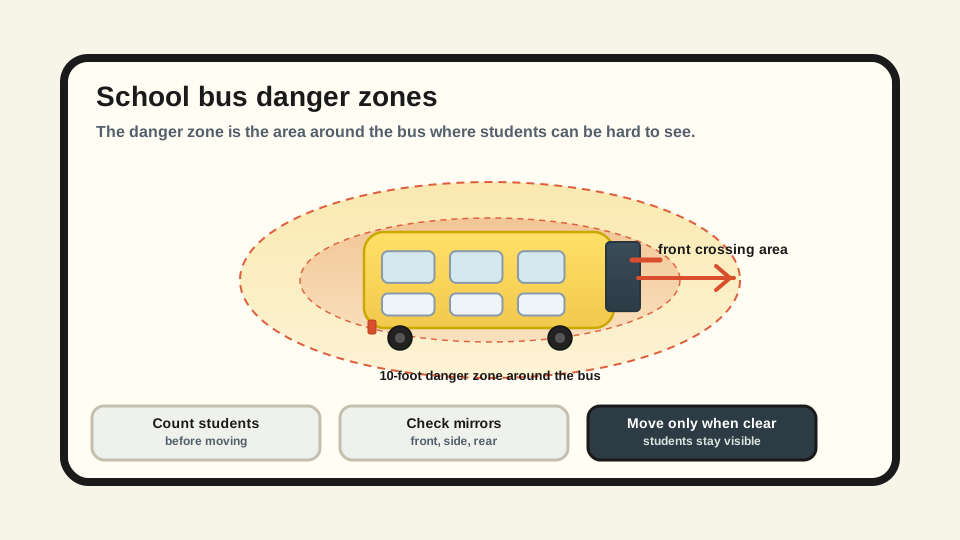
What is the danger zone around a school bus?
Danger zones are the areas where students can be hardest to see.
School bus drivers must understand the danger zones around the bus because children can be hidden from view near the front, sides, and rear.
Source focusCDL Manual - School Bus: danger zones
Study focusProtect students during loading, unloading, crossings, inspections, and emergency situations.
Common trapTreating a school bus stop like a normal passenger stop instead of a student-safety event.
Question 2
Before loading or unloading students, what is the safest priority?
Student loading and unloading requires controlled stopping, warning devices when required, and constant attention to student location.
Source focusCDL Manual - School Bus: loading and unloading
Study focusProtect students during loading, unloading, crossings, inspections, and emergency situations.
Common trapTreating a school bus stop like a normal passenger stop instead of a student-safety event.
Question 3
Why must a school bus driver count students during loading and unloading?
Counting and tracking students helps prevent moving the bus while a child is still near the vehicle or crossing the road.
Source focusCDL Manual - School Bus: student control
Study focusProtect students during loading, unloading, crossings, inspections, and emergency situations.
Common trapTreating a school bus stop like a normal passenger stop instead of a student-safety event.
Question 4
What should a school bus driver do before crossing railroad tracks when required to stop?
School buses have special railroad crossing duties. The driver should stop when required, look and listen carefully, and avoid unsafe actions on the tracks.
Source focusCDL Manual - School Bus: railroad crossings
Study focusProtect students during loading, unloading, crossings, inspections, and emergency situations.
Common trapTreating a school bus stop like a normal passenger stop instead of a student-safety event.
Question 5
During a school bus evacuation, what is the safest driver priority?
Evacuation is about protecting students after they leave the bus. The driver should direct them to a safe location and keep them organized.
Source focusCDL Manual - School Bus: emergency evacuation
Study focusProtect students during loading, unloading, crossings, inspections, and emergency situations.
Common trapTreating a school bus stop like a normal passenger stop instead of a student-safety event.
Question 6
Which item is especially important in a school bus pre-trip inspection?
School bus inspection adds student-safety equipment and loading controls to normal vehicle checks. Warning systems, exits, mirrors, and stop arms matter directly to student safety.
Source focusCDL Manual - School Bus: inspection
Study focusProtect students during loading, unloading, crossings, inspections, and emergency situations.
Common trapTreating a school bus stop like a normal passenger stop instead of a student-safety event.
Question 7
A student drops an item near the front of the school bus after unloading. What is the safest driver response?
Children near the bus are in a high-risk area. The driver should keep them visible and never move until the danger zone is clear.
Source focusCDL Manual - School Bus: danger zones
Study focusProtect students during loading, unloading, crossings, inspections, and emergency situations.
Common trapTreating a school bus stop like a normal passenger stop instead of a student-safety event.
Question 8
Why is mirror adjustment especially important for a school bus driver?
School bus mirrors help the driver see areas near the bus where students may be present, including zones that are difficult to see directly.
Source focusCDL Manual - School Bus: mirrors and student safety
Study focusProtect students during loading, unloading, crossings, inspections, and emergency situations.
Common trapTreating a school bus stop like a normal passenger stop instead of a student-safety event.
Question 9
When students must cross the road after leaving a school bus, what should the driver do?
Student crossing is one of the highest-risk school bus tasks. The driver should control the stop, watch the students, and allow crossing only when the area is safe.
Source focusCDL Manual - School Bus: loading and unloading
Study focusApply safe student crossing procedures after unloading.
Common trapLetting students cross before traffic is fully controlled.
Question 10
Why should a school bus driver check the danger zones before moving after a stop?
Students can be hidden around the front, sides, and rear of the bus. The driver should verify the danger zones are clear before moving.
Source focusCDL Manual - School Bus: danger zones
Study focusUse danger-zone checks before moving a school bus.
Common trapAssuming students are clear because the door has closed.
Question 11
A student is late and runs toward the bus from across the street. What is the safest response?
A running student can enter traffic or a danger zone quickly. The driver should stay stopped and control the situation until it is safe.
Source focusCDL Manual - School Bus: student management at stops
Study focusChoose safe actions when a student approaches unexpectedly.
Common trapPrioritizing route timing over controlling student movement.
Question 12
What should a school bus driver verify after the last student leaves the bus?
A post-stop and post-route check helps prevent leaving a child on the bus or moving while a student is near the vehicle.
Source focusCDL Manual - School Bus: student accounting
Study focusUse post-stop checks to account for students.
Common trapChecking mirrors only once and assuming all students are gone.
Question 13
At a school bus stop, what is the safest reason to use mirrors continuously?
School bus stops require constant observation. Mirrors help the driver monitor students near the bus and traffic around the stop.
Source focusCDL Manual - School Bus: mirrors
Study focusConnect mirror use to student safety at stops.
Common trapUsing mirrors only for lane changes instead of student protection.
Question 14
What should a driver do if the stop arm or student warning lights do not work before a school bus route?
Student warning equipment controls traffic during loading and unloading. A defect can expose students to serious risk.
Source focusCDL Manual - School Bus: inspection and warning devices
Study focusIdentify student warning equipment defects as serious safety issues.
Common trapTreating warning-light defects as minor electrical problems.
Question 15
Why should students be kept together after an emergency evacuation?
After evacuation, the driver still has responsibility for student safety. Keeping students together helps account for everyone and keeps them away from danger.
Source focusCDL Manual - School Bus: emergency evacuation
Study focusManage students after a school bus evacuation.
Common trapThinking the evacuation is complete as soon as students leave the bus.